Learning Outcomes
Upon successful completion of this lesson, students will be able to:
i. Define and explain the concept of the instruction cycle, recognizing it as the fundamental process by which the CPU executes instructions.
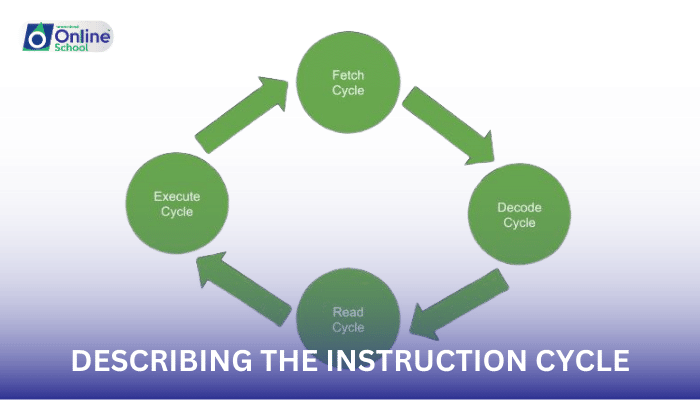
ii. Identify the three distinct phases of the instruction cycle: fetch, decode, and execute.
iii. Understand the role of the fetch phase in retrieving instructions from memory, ensuring a steady supply of commands for execution.
iv. Grasp the function of the decode phase in deciphering the instruction's meaning, identifying the operation and operands involved.
v. Explain the purpose of the execute phase in carrying out the specified operation, performing the actual computation or data manipulation.
vi. Recognize the significance of the instruction cycle in enabling the CPU to process instructions efficiently, forming the foundation of program execution.
vii. Appreciate the intricate interplay of the fetch, decode, and execute phases, highlighting their collaborative role in bringing instructions to life.
Introduction
Within the realm of computer architecture, the instruction cycle serves as the heartbeat of execution, orchestrating the seamless processing of instructions. It's like a well-rehearsed dance, where each component of the CPU plays a specific role in transforming instructions into actions. In this lesson, we embark on a journey to uncover the secrets of the instruction cycle, exploring its three crucial phases and understanding their harmonious collaboration in bringing programs to life.
i. The Fetch Phase: Retrieving the Instruction Blueprint
The fetch phase acts as the instruction retrieval mechanism, reaching into memory to retrieve the next instruction to be executed. It's like the librarian fetching a book from the shelf, providing the CPU with the blueprint for the next task. The Program Counter (PC) plays a crucial role in identifying the memory location of the next instruction, ensuring the sequential execution of the program.
ii. The Decode Phase: Deciphering the Instruction's Meaning
Once an instruction is fetched, it enters the decode phase, where the CPU deciphers its meaning. It's like a code translator, unraveling the instruction's binary code and identifying the operation to be performed and the operands involved. The Control Unit (CU) takes center stage in this phase, interpreting the instruction and directing the appropriate components to prepare for execution.
iii. The Execute Phase: Bringing Instructions to Life
Finally, the execute phase arrives, where the instruction's specified operation is carried out. It's like the construction worker putting the blueprint into action, performing the actual computation or data manipulation. The Arithmetic and Logic Unit (ALU) takes the lead in this phase, handling arithmetic and logical operations, while other components, such as registers and memory, provide the necessary data and storage.
The instruction cycle, with its three distinct phases of fetch, decode, and execute, provides the fundamental framework for the CPU to process instructions efficiently. The fetch phase retrieves instructions from memory, the decode phase deciphers their meaning, and the execute phase carries out the specified operations. Together, these phases form the backbone of program execution, transforming instructions into actions and enabling the computer to perform its tasks.
